Showing posts with label conventions. Show all posts

Tuesday, October 11, 2022

Running A Con Game Part 2: Table Prep And Behind The Screen

This summer, I offered some advice on how to plan and write a scenario you'll be running at game conventions. Now that you have your new player-killer in hand and folks are starting to gather at the table, let's talk about some advice on how to run it.

1. Provide pregens, and have more of them than your players. At a convention game, you have 4 hours - tops - to run the entire scenario. If you think you'll have everyone rolling up new characters before getting started, think again. Even if everyone at the table is familiar with the system, it'll likely take them 30 minutes to roll stats, look up skills/magic spells, decide on equipment, etc. And if you have a few players who are first-timers, that will add even more downtime. Steer clear of anything that would take away adventuring time and have pregens ready for folks before they sit down. And as an addendum: the players will still like to have some degree of choice as to who/what they'll be playing, so have twice the number of pregens available. If you have 6 players, have 12 (or more) pregens available so everyone has a chance to pick and choose rather than getting locked into "whatever character's left".

2. Bring extra pencils and dice. But keep rulebooks minimal. Although most players who come to your table are super-prepared, there may be someone who signed up at the last minute and/or showed up with a friend who now wants to play in your cool-looking game. Make sure you have some extra pencils and dice for this late-comer so they're not trying to borrow off of the other players at the table. But conversely, try to keep rulebooks and other tomes away from your table during play. The GM should be the only one who needs to look anything up (and honestly, you shouldn't have to look anything up if you're duly prepared). There may be some table or bit of minutiae to clarify, but you should be prepared to make rulings on the fly rather than get bogged down trying to find Table 3.24 on page 232 just to look up appropriate Exit Wound Size. (And don't let any player bring out a rulebook to debate a ruling you just made. Shut that down ASAP.)

3. Keep track of time. You have 4 hours to run the game, and you don't want to run out of time before finishing, nor do you want to reach the end way ahead of schedule. So keep an eye on the clock while you play. You can use a watch or a timer on your phone. I prefer to use a kitchen timer behind my screen so that I know how much time I have left at a glance. I can use this to gauge my timing of events as we play to ensure we reach the endgame before time runs out. At the 2-hour mark, we should be halfway through the adventure. If not, I start altering future scenes to speed things up (lowering the number of monsters and/or goons or bypassing entire scenes if they don't contribute to the overall scenario). If we're running fast, do the opposite and add a few extra monsters/scenes to slow them down. You also want to try to finish a few minutes early so you can say your goodbyes, thank you players, and clean up the table for the next game. Nothing more frustrating than waiting for folks to clear out from a game that ran long and is now starting to eat into your time. So don't be that person and wrap up on time or earlier.

4. Protect your voice by staying hydrated and have some lozenges. You're gonna be talking a lot. And your voice is gonna be a bit hoarse after that first game. But you have another one to run later that day. And the next day. And the next day. And if you're in a crowded gaming hall, you might be shouting over the din. You'll want to protect your voice as best you can. My suggestion is to have a bottle of water behind the screen and sip from it every so often, even if you're not thirsty. Keep those pipes moist to counterbalance all of the air you're throwing over them. Secondly, I have a pack of sore throat lozenges at hand that I'm constantly munching on. This helps soothe your throat before it gets too sore. I've found that a lozenge every hour or so during gametime keeps you from losing your voice before the convention ends.

5. If you must take a break, have only one, and keep it 5 minutes max. Four hours is a long time at the table, especially if everyone is chugging water, energy drinks, etc. Although folks will often be engaged and will want to keep playing, it's usually a good idea to stop at least once at the halfway point to allow folks to run to the bathroom and/or stretch their legs a bit. However, you don't want to lose too much game time and you certainly don't want to play sheepherder and try to round them all up, so set a firm time limit of 5 minutes on any breaks. After 5 minutes, pick up where you left off regardless of who's back, and have the stragglers join the game in progress. (And do not, under any circumstances, let anyone race to the vendor's room to "pick something up". Nine times out of ten, they'll never return to the game.)

6. Have some swag or takeaway for the players. It's always a nice gesture to have something to give to the folks who decided to take a chance on your game. Some game companies, like Goodman Games, provide swag for those who run their games. Stickers, note pads, quickstart rules, pencils, dice, etc. remind folks of the fun they had and may prompt them to buy the game and run sessions of their own. I admittedly go a bit overboard with my swag and have had custom dice, supplements, and other giveaways printed up for folks. One year I gave away mini-multitools like the ones found within the scenario I ran. (And this year's convention swag is a very special "parting gift" from one of my NPCs!) You don't need to have anything this fancy; heck, a bowl of candy on the table as you play is a nice gesture for gamers to refuel as they head to their next game.

Stay tuned for "Part 3: Tips and Tricks for Surviving Your First Game Convention" in a future missive from The Savage AfterWorld!

Friday, June 3, 2022

Running A Con Game Part 1: Planning And Writing Your Game

Since the 1980s, I've run many (many) RPG sessions at game conventions across the country - from classics like D&D, Ghostbusters, and Chill to newer games like Mutant Future and MCC. One one thing I always try to do at these events is to run adventures that I've written myself. My reasons are manifold:

  1. If it's a game I wrote, I know all of the plot points, NPCs, and locations intimately, so I'm more comfortable at the table and can make up something on the fly (rather than looking up some bit of unfamiliar minutiae every 5 minutes).
  2. I can custom-tailor the adventure for the time allotted, ensuring that the players get to the endgame before time runs out.
  3. It's good for my ego when the players enjoy the game as it's an adventure I myself designed!

As we move into convention season, I thought I'd take a moment and toss out some tips I've learned over the years to fledgling Judges, DMs, GMs, Referees, and what-not. This blog entry will cover planning your game and getting it written and designed -- advice for everything leading up to the game itself. A future blog post will discuss running your convention game and tips at the table.

1. Write a game that can be completed in 4 hours. Most conventions schedule games to run in 4-hour blocks. With this in mind, you should write your game to fit into this time period. This may sound daunting if you have a lot of encounters and combat in mind. Well, stop that. The typical table has 4 to 6 players, and each encounter will likely take 30 minutes for the team to get through. So, easy math: 4 hours divided by 30-minutes-per-encounter equals roughly 8 encounters. However, you'll lose 30 minutes at the beginning of your slot to game prep (passing out sheets, making sure everyone has dice and pencils, explaining the system to new folks, etc.) and you'll likely want to plan to wrap up 10-20 minutes early so you don't stomp on the next game slot. So - realistically - your adventure should be 6 solid, in-depth encounters. Doesn't sound like much, but it is plenty, believe me.

2. Have a beginning, middle, and - most importantly - an ending. I've heard from players over the years that there is nothing more frustrating than to play for several hours and, just as they reach the door to The Ultimate Bad Guy Lair... 

time'supsorryabouthatwe'llpickitupnextyear. 

The players want that resolution and it's not fair to just end the game mid-plot. So when you write your game, have the endgame solidly in mind and make sure your adventure is short enough that they'll reach that EPIC CONFRONTATION at the end.

3. No sandboxes, but no railroads either. This is a tricky tightrope to walk. If your game is too wide open, the players may not discover your oh-so-obvious clues and will struggle to progress forward. You need to herd them a bit as time is short. By the same token, a simple A to B to C to D railroad game takes away player agency as now they're just along for the ride. Each encounter in your game should have multiple ways the players can overcome it: they can bluff their way through, fight their way through, sneak their way through. But each encounter leads down the path to the next encounter, but depending on their prior actions the encounter has changed. Did they fight to get here? Guards are now on alert and well armed. Did they bluff? Now they need to maintain the masquerade. Did they sneak? They now enter at a completely different location. Give them agency, but keep everything moving toward the climax.

4. Give everyone something to do. When you're providing the character sheets, you know what your players are going to be able to do ahead of time! If you're giving them a thief, you better have some locks to pick or some wall to climb. Have a wizard? There should be some runes for them to translate or even a magical rival itching for a spellduel! (And, of course, have some combat to keep the fighter - hell, EVERYONE - happy!) Make sure the adventure you're writing has enough character-specific elements so that each player gets a chance to contribute to the party's success.

5. Make everyone a star at some point. We're hedging into "At the Table During the Game" advice, but this is a corollary from the previous rule. Some folks may shy away from the spotlight, deferring to the more boisterous players at the table. Don't let that happen. Everyone should feel they contributed to the party's success at the end. The dice may be the final decider of fate, but as the judge, YOU have the ability to reshape the world as you see fit on the fly. For example, if the Quiet One is playing a cleric - "Oh no! Now there are ghosts that can't be hit by physical weapons and must be turned!" Offer them the chance to step up and be the hero. That's why we play these games right?

6. Give your players their money's worth. Typically, convention game players have paid good cash money to play in your game. No pressure! All kidding aside, players want one primary thing from your game -- a story they can tell their friends about later. Don't toss together a series of cliches, but rather give them something they've never seen before! New locations found only in their most fevered dreams and creatures that live in their nightmares! I typically begin writing by asking myself one question: "What has NO ONE ever seen at the game table before?" It could be a place or a beast or an NPC or a quest - but that is always the spark that ensures the players will get their money's worth. (Oh, and a bit of take-home swag from the game is always a bonus!)

7. Here's some of the best advice on writing a convention game I've ever found. Years ago, I discovered a series of blog posts titled "How to Run Con Scenarios the Gar Hanrahan Way."  Writer and game designer Gareth Hanrahan posted a series of incredibly useful tips and tricks on how to write and run a game specifically for a convention setting. His old gaming blog is long gone, as well as these posts. But before that happened, I grabbed his advice, put it together in a PDF, and printed it out and binded it for my own personal use. I later posted it to Google Drive so others can benefit from these great tips. (And Gareth seems to be cool with it!


Stay tuned for "Part 2: Running Your Convention Game" in a future missive from The Savage AfterWorld!


Saturday, July 30, 2016

Organize Your Convention Travel Data With Your Own Personal PC Record Sheet

When attending a game convention, there's a ton of information you need to have on-hand -- your flight number, your hotel reservation number, a checklist of everything you need to take, your planned purchases, your game schedule, etc. When I go to a con, I have all of this info printed out and tucked into folder I take with me. Convenient, yes, but very cumbersome. 

Brandon Kruse of D&D Doodles felt the same about his various checklists and schedules, so he created the "Unofficial GenCon Character Sheet." Styled like a typical PC character sheet, the form has a place for all of your travel info as well as your schedules, checklists, and other important information all on one sheet. Incredibly useful, and the design of the form is a masterstroke. Although tagged with GenCon's logo, this sheet will come in handy for *any* game con you plan to attend. I've already downloaded it and I plan to print a few for my upcoming con attendance this year. Great work, Brandon!

Tuesday, June 2, 2015

"Change" Your Convention Attendance: An Experiment


As the convention season gets well underway, I start hearing the same complaints and moaning that I hear every year. "Woe is me. I'm so broke. You gotta be 'Moneybags Von Richeyrich' to afford to go to a game con." To these Murderhoboes-Without-Funds, I'm offering you these words of advice:

Check your pockets.
Those loose coins are instrumental in getting you there.

I sure I'm not alone when it comes to saving my loose change in a change jar at home. But how many of you have any purpose for those coins? My college roommate used to drop all of his spare change into a big ol' jug every night. At the end of the year, that change jar paid his share of the rent for that month. And the money he saved by doing that would buy him a night's debauchery at the campus bars. So I started to save my change in a similar manner.

For years, I've dropped every penny, every nickle, every dime, quarter, and silver dollar into my change jar. I never spend change. I always break a dollar with every purchase, just to build up that extra change. (It drives my wife nuts -- she always pays with exact change.) I'll even stoop to pick up pennies found in the parking lot. I'm not picky at all. It all goes into the change jug. Then, once a year, I'll change it out, and I'm always pleasantly surprised by how much has built up.  It's like "found money" in my mind, since I really don't miss the coins I toss into the jug. So what do I do with all these coins? Ah...

For years, I've used my yearly accumulated coinage to somehow fund part of a vacation that year. One year, my spare change bought me a round trip plane ticket to Vegas and back. Another year, I used my accumulated spare change for all of my Gen Con Dealer's Room purchases. My spare change has been earmarked for hotel rooms, admission fees, and extra-special purchases costing far more than I'd normally pay.

It's ironic, but I've made "2,000 copper pieces" work for me!

I hope some of my cheerleading for spare change hoarding gets some of you "Always-Brokes" thinking about starting your own change jar. Dump your forgotten coins into it, let it grow, don't raid it for beer and cigars, and in a year, you'll have enough to help fund that convention sojourn you've always wanted to take.

Now about that "experiment" I mentioned in this post's title. I'm planning on putting my money where my mouth is. That pile of coins you see in the photo above is part of this year's coin fund. I've been saving up since last October. (My Con on the Cob attendance was partially funded last year by The Coins.) So that's roughly 7 1/2 months of coinage accumulated. This Saturday, I'm going to make a day trip to Origins Game Fair in Columbus. And that entire day will be solely funded by the contents of my coin jug. (Cashed out into bills, of course. I don't want to pay the vendors with rolled pennies...) To avoid temptation, I'll leave any additional cash at home, as well as my credit cards. Gas there and back, parking fees, badge registration, game tickets, vendor purchases, food, etc. Everything will be funded by my accumulated spare change that day. (I'll provide the financial breakdown once the day has ended.)

So that's the challenge. This weekend, I'll live-blog from Origins as I usually do from game cons. (Although, since it's a day trip, I'll blog about it upon my return home.) And if I can afford to attend a game convention for one day with nothing more than the coins in my pockets and the change between the couch cushions, I hope it might inspire some of you "Always-Brokes" to save up for one year so you can do the same.

Sunday, September 28, 2014

A Pre-Generated Notion (Or "No, You Can't Play Your 12th-Level Barbarian Blood-mage In My Convention Game")

/begin soapbox rant

By way of background, I've been running pick-up games and convention scenarios for 30-plus years. And, with rare exception, you'll have your choice of several pre-gens I'll be providing as we sit down to play. No, we won't be rolling up new characters. No, you can't play a new character you rolled up and brought with you. And, super-no, you can't bring your home character to play.

So why the hard-nosed approach? Certainly, any GM worth his salt should be able to work these newly-created and/or home-spun PCs into a quickie pick-up game, right? Well, over the years, I've found it to be more trouble than it's worth. And now that we're entering convention season (for me anyway), I thought I'd explain my position on this matter.

1. Time is limited. During a typical convention game, we have 4 hours tops to get from point A to point B. When you have 6 folks rolling up a new character at the table, it takes 20-30 minutes away from our limited game time. (Perhaps longer if someone is new to the system.) So pre-gens cut the PC generation time to mere seconds. ("Here, pick one.")

2. Necessary "detachment." When you take the time to create a new character, you become "invested" in that character. And folks who are attached to their characters take fewer risks. They're cautious. They think things through. In other words, the action slows to a crawl. However, with a pre-gen, you have a "disposable character." A player will do crazy, off-the-cuff stuff. Risks are taken, action is non-stop, and the story moves along. And if they die horribly 30 minutes into the game? Eh, who cares? Have another pre-gen.

3. Additional game-related info. The pre-gens I give you at the table aren't just a stack of stats. I give each pre-gen some background information that only he or she knows about the scenario the players are entering. Through their pre-generated PC, each player is given some vital clue, some needed piece of equipment, or a skill that's important to the adventure. My pre-gens are actually part of the game. Characters brought in from "outside" won't have that clue, skill, or object necessary to further the game.

4. Game-breakers. I've personally encountered this when someone brings their home character into a convention game. Their PC will have some skill that I didn't account for when designing the adventure which totally sends the game off the rails.
"OK, when the game begins, you are captured by the orcs. After tossing you into a cage, they grunt amongst themselves, formulating their secret plans."
"Oh, did I mention my character is fluent in orcish? I eavesdrop on them so we know exactly what they're up to."
"Er..."
This also encompasses the +8 Holy Reaver your character possesses, the ninja skills you gained when training at The Ninja Academy, and anything else that pushes your character into Superhuman Levels of Kickassery. I just can't account for every potentiality so it's better if you just leave Cap'n Asskicker at home. The pre-gens all start on equal footing. No one is more powerful or more useful to the game than anyone else.

5. "I'm the star." Folks who bring in their personal PCs have a history with that character -- a history that they'll bring to the table. It sometimes becomes an impromptu "let me tell you about my character" situation. Even worse, it becomes a "let me SHOW you about my character" situation. It's no longer about the adventure, but rather it becomes the "Ragnarok the Barbarian Solo Quest Adventure Hour -- Plus Five Other Guys." They see every encounter as another opportunity to show everyone how awesome their character is, and they'll treat the other players like NPCs. With pre-gens, there are no stars.

Lest you think I'm a bit of an ogre, I will admit that I've made "special arrangements" in the past if someone contacted me beforehand and asked if they could bring a home PC into my convention game. If I can make some prior adjustments here or there in my game script or in your PC's skillset, then it sometimes isn't a problem. In fact, I get a bit of a thrill knowing that my game just became a part of your PC's continuity. However, if you blindly show up with a character sheet in-hand and demand that I let you play it, don't start pouting when I ask you to put him away and take a pre-gen. And if you happen to storm off due to this affront, I won't feel badly for you. In fact, I'll feel I've just done the other players at my table a great service.

/end soapbox rant

Thursday, May 29, 2014

Sharing My "Gaming Con Passport"

North Texas RPG Con is less than a week away, and I'm putting the finishing touches on my games. Chronoscooters are warmed up, members of ISCX are on alert, and a certain toon barbarian and his friends are on their horses and heading south. All that's left is the packin'.

I think most folks who attend gaming conventions like to pick up some souvenir to show that they've been there, done that. Like most, I have a pretty wide selection of con t-shirts, but I'm not too keen on packing them and wearing them at other conventions. For some reason, wearing a Gencon shirt at Origins just feels "off" to me. I also have several caps with convention logos on them I've picked up. (I may pack one to wear, but that's just my penchant for caps.)


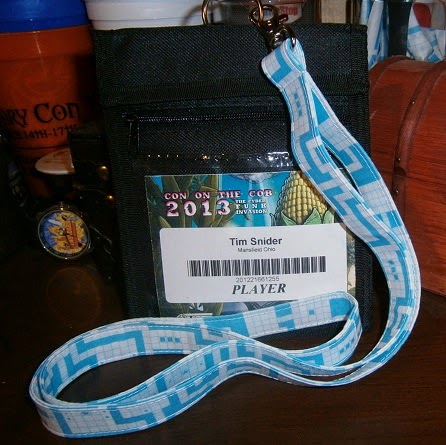
But I'd like to share my favorite "gaming con passport" that I have with me at every convention I attend. I have a "neck wallet" that I use to hold my convention ID. (I'm sure many of you have something similar.) I got my first one at Gencon years ago, but this is the one I currently use. I recently had a custom lanyard made using the dungeon map cloth I designed. Well, tucked inside the wallet is my collection of con badges from all other conventions I've attended. The day I get home from a gaming con, the newest "been there, done that" ticket gets tucked in amongst the others. It's become a snapshot of sojourns I've taken. So, do you have a way to mark each con you've been to?